 Draxon VR Training Syllabus
Exam: Aircraft Arrival
 Virtual Reality
Duration
1-2 Minutes
Training Type
Initial Training
IATA Standard
IATA AHM 1110, Edition 46 & IATA IGOM, Edition 14
Languages
English, German, Dutch, Spanish, French, Greek, Arabic, Cantonese Chinese, Turkish
Description
This exam tests the trainee's knowledge of the complete aircraft arrival process. It evaluates knowledge of PPE use, F.O.D. detection, safe aircraft approach and positioning, chock and cone placement to prepare for independent ground-handling duties.
Description
This exam tests the trainee's knowledge of the complete aircraft arrival process. It evaluates knowledge of PPE use, F.O.D. detection, safe aircraft approach and positioning, chock and cone placement to prepare for independent ground-handling duties.
Exam Overview
- 1Fifteen-question multiple-choice test
- 2Questions cover PPE, FOD inspection, ramp safety awareness, chocking, and coning procedures
- 3Each question provides instant feedback and corrective guidance
- 4A minimum score of 80% (12 correct answers) is required to pass
Skills Acquired
- Correct selection and use of Personal Protective Equipment (PPE) in ramp-side operations
- Identification, assessment, and safe removal of Foreign Object Debris (FOD)
- Accurate interpretation of ramp markings, operational signals, and hazard zones
- Demonstration of situational awareness and adherence to airside safety procedures during aircraft arrival
- Correct placement of chocks on aircraft wheels to prevent unintended movement
- Positioning of cones to establish clear safety zones around the aircraft
Exam Procedure
- Fifteen multiple-choice questions test comprehension of ramp safety, aircraft arrival, chocking, and coning standards and best practices.
- Each response receives immediate feedback, highlighting correct and incorrect answers.
- A score of at least 80% is required for successful completion.
- Upon finishing, the system confirms passing of the theoretical exam which means readiness to move towards practical apron operations.
Sample Exam Questions
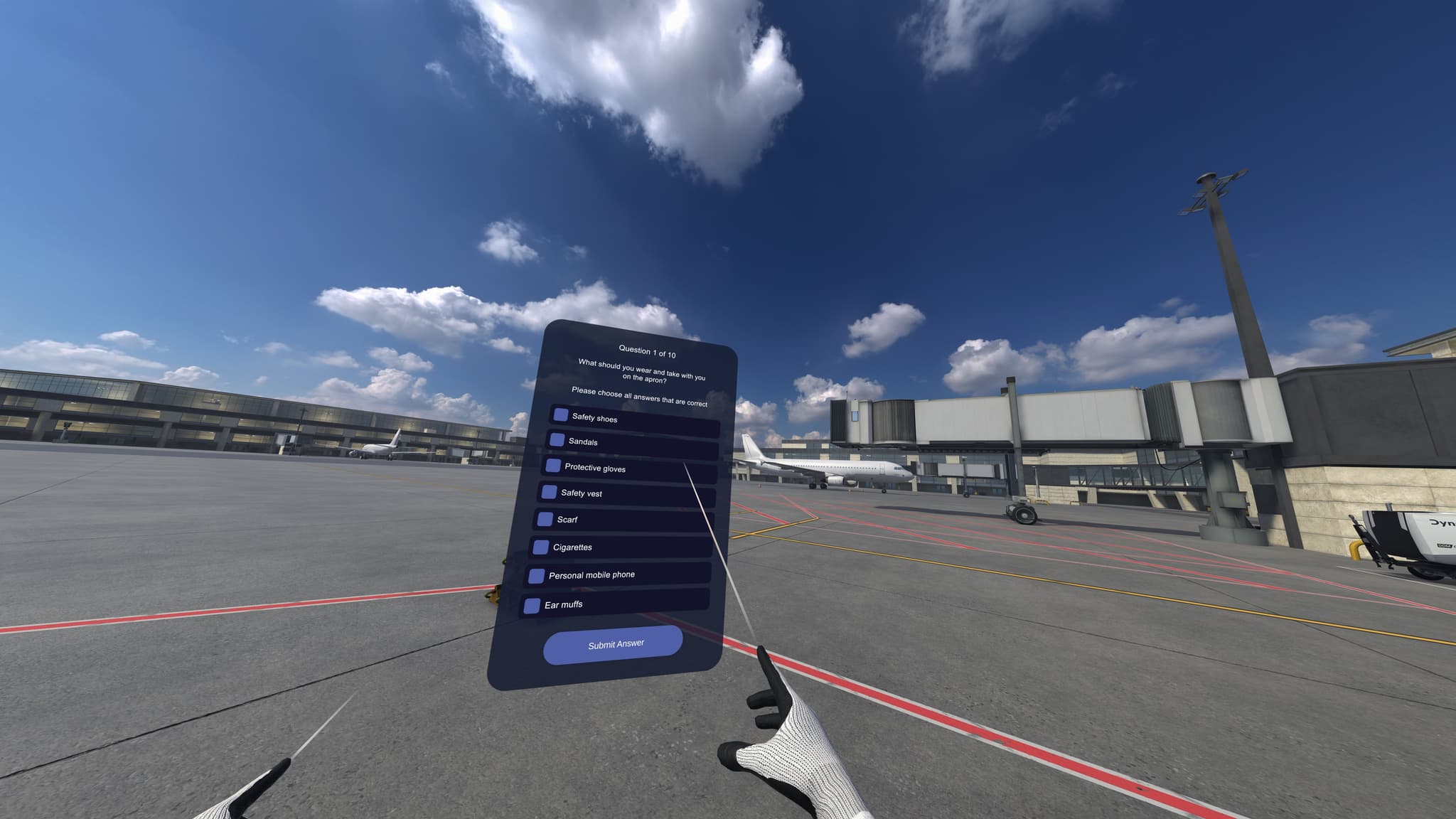
- What should you wear and take with you on the apron?
- Do you always have to wear your safety vest on the apron?
- Why do you need to wear ear protection on the apron?
- What do you do if you see trash or F.O.D. on the apron?
- Why is it important to remove F.O.D.?
- After you have found four F.O.D.s, can you stop searching?
- When the aircraft is taxi-ing into the apron, can you cross the line into the Equipment Restraint Area (ERA) and approach it to save some time?
- What does the line on the apron that delineates the Equipment Restraint Area (ERA) mean?
- What does the aircraft beacon light mean when it is flashing?
- Can you walk under the aircraft wing while the aircraft is taxiing in?
- Where do you place the chocks on the aircraft wheels?
- Why is it important to put chocks on the aircraft wheels?
- Where do you place the cones around an aircraft?
- Where should cones NOT be placed?
- If you do not find cones, can you use chocks instead of cones to highlight a safety zone?